
Water damage gets more expensive by the hour. What you do in the first day usually decides whether this is a cleanup or a reconstruction.
Wet materials do not stay merely wet. Water wicks into drywall, migrates under flooring, and soaks the framing behind your walls. Somewhere between 24 and 48 hours, mold growth begins in earnest — and at that point you are no longer drying a room, you are removing and rebuilding parts of it.
Here is the order of operations we would give any homeowner or rental owner in Santa Rosa Beach, Sandestin, or along 30-A.
Before anything else: if water is anywhere near outlets, the electrical panel, or submerged appliances, do not wade in. Shut power to the affected area at the breaker only if you can reach it safely. If you cannot, stay out and call an electrician or the fire department. If a ceiling is sagging or bowing, stay out of that room entirely.
Hour 1: Stop the water
Find the source and shut it off. For a burst supply line, appliance hose, or overflowing fixture, that means the main shutoff valve. For a roof leak or storm intrusion, it means containing it — buckets, tarps, and moving what you can out of the path. You cannot dry anything while more water is still arriving.
Hour 1 to 2: Photograph everything before you touch it
This is the step people skip and regret. Before you move a single item, take wide shots of each affected room, then close-ups of standing water, soaked baseboards, wet ceilings, and damaged contents. Get the source of the leak in frame if you can. Insurance adjusters work from evidence, and once you have cleaned up, the evidence is gone.
Hour 2 to 4: Call it in
Two calls. Your insurance carrier, to open a claim and get a claim number. And a restoration company, because the drying equipment matters more than the mop. Most policies expect you to take reasonable steps to prevent further damage, so acting quickly protects the claim as well as the property. Ask your carrier what they need documented before you start removing anything.
Hour 2 to 6: Get standing water out and air moving
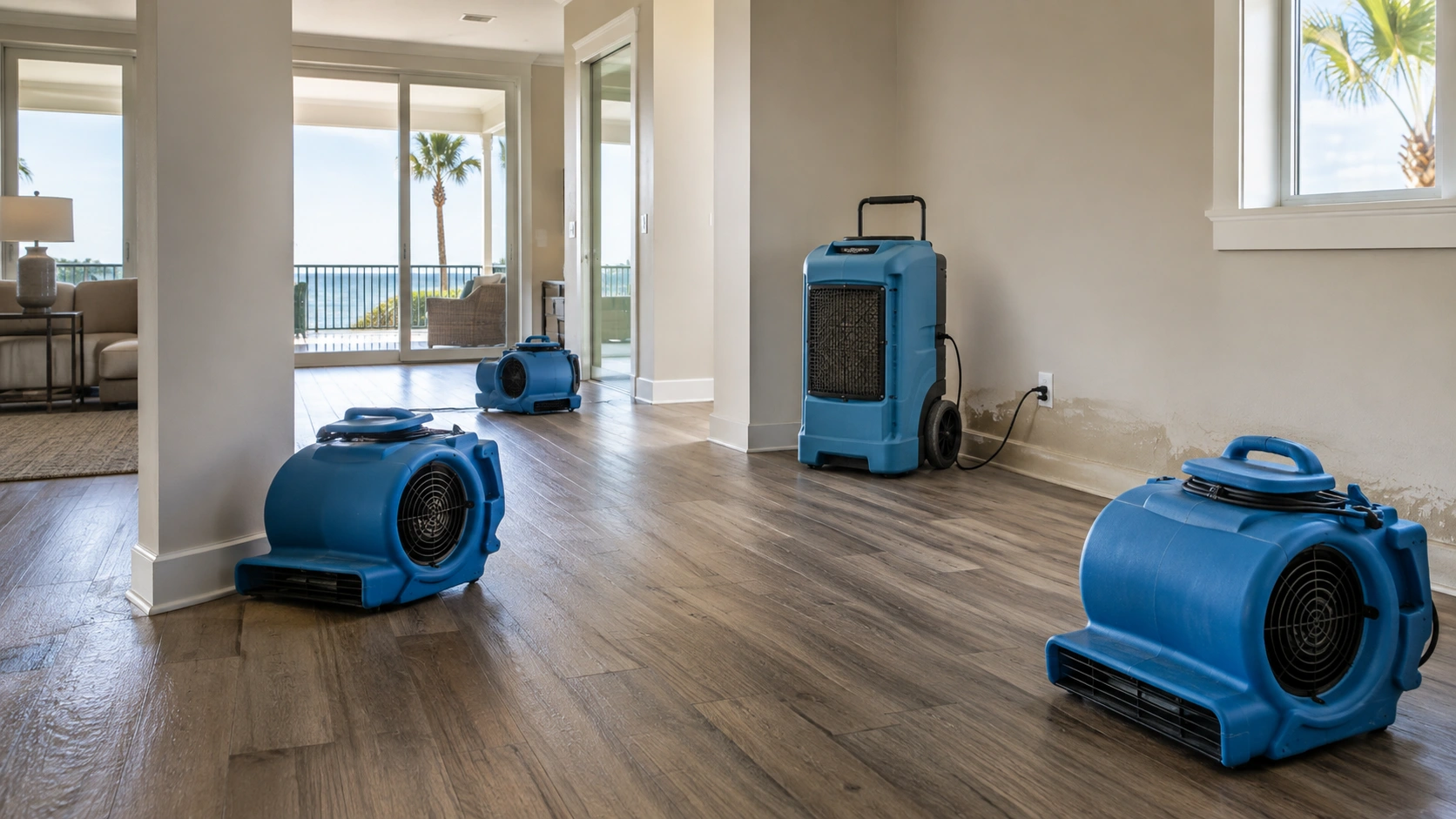
Remove what water you can with a wet/dry vac, mop, or squeegee. Open windows only if the air outside is drier than the air inside — on a humid Gulf Coast day, running the AC does more good than an open window. Run fans to move air across wet surfaces, and pull back rugs and small furniture so the floor underneath can breathe.
Hour 4 to 12: Get soft materials out of the room
Wet rugs, cushions, bedding, cardboard boxes, and upholstered furniture hold moisture against the floor and feed mold growth. Move them somewhere dry, or outside if the weather allows. Lift furniture legs onto foil or blocks so the finish does not bleed into wet carpet.
Hour 12 to 24: Understand what you cannot see
This is where do-it-yourself drying usually falls short. A floor can feel dry to the hand while the subfloor beneath it and the wall cavity behind the baseboard are still saturated. Professional crews use moisture meters and thermal imaging to find that trapped water, then place air movers and dehumidifiers to pull it out. Skipping that step is how people end up with a mold problem weeks later in a room they thought they had handled.
When it stops being a DIY job
A cup of water on tile is a towel. Beyond that, call someone if any of these apply:
- The water came from a sewer line, a toilet backup, or floodwater from outside — that is contaminated and needs proper handling, not a shop vac
- Water has been sitting more than 24 hours
- It reached drywall, insulation, cabinetry, or subfloor rather than just a hard surface
- You can smell must or damp, which means moisture is already somewhere you cannot see
- It is a rental or second home and nobody has eyes on it daily
Most people underestimate how far water has traveled, because the visible puddle is the smallest part of the problem.
Dealing with water damage right now?
We answer 24/7 and can usually be on site the same day. Serving Santa Rosa Beach, Sandestin, Miramar Beach, and the 30-A corridor.
Call 850-835-3334Get A Free Quote
Comments are closed.